Antitrust lawsuit against 32 colleges with early decision can proceed, judge rules
An article from Dive Brief Antitrust lawsuit against 32 colleges with early decision can proceed, judge rules
However, U.S. District Judge Angel Kelley dismissed the claims against Common App and other noncollege defendants.
Published Aug. 11, 2026 Laura Spitalniak Editor
-
 Share
Share-
 Copy link
 -
 Email
Email -
 LinkedIn
 -
 X/Twitter
 -
 Facebook
 -
 Print
Print
-
-
 License
 -
 Add us on Google
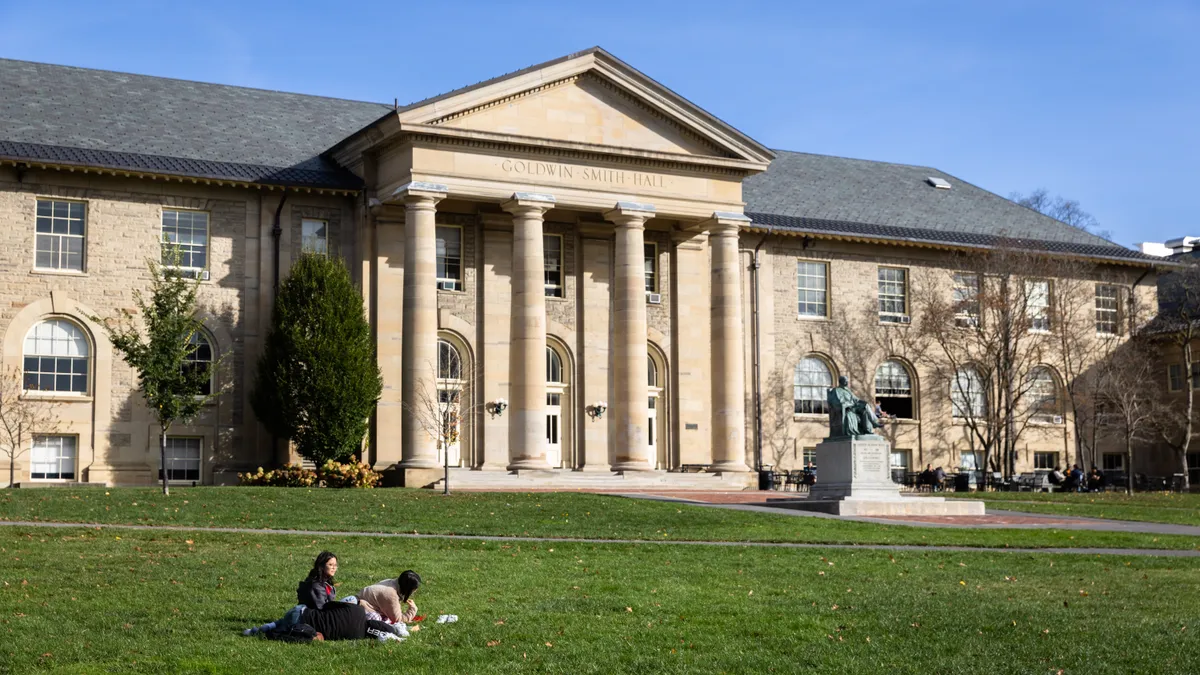
Cornell University students sit outside on Nov. 3, 2023, in Ithaca, N.Y. Cornell is one of 32 selective colleges being sued over early decision admissions practices for undergraduate students. Matt Burkhartt via Getty Images Listen to the article 5 min This audio is auto-generated. Please let us know if you have feedback. Dive Brief:
- Thirty-two highly selective colleges will have to face an antitrust lawsuit over their use of early decision admissions, a federal judge ruled Friday.
- In a lawsuit filed in August 2025, current and former college students alleged the institutions used early decision to artificially lower competition for students, charge higher tuition and offer less financial aid.
- The colleges sought to have the case thrown out, but U.S. District Judge Angel Kelley ruled last week that the case could proceed. However, she dismissed the claims against two college application platforms — Common App and Scoir — and the Consortium on Financing Higher Education, a coalition of liberal arts institutions that all of the college defendants are or were members of.
if (window.dfp_visibility === 'mobile' ) googletag.cmd.push(function() googletag.defineSlot( '/3618/highereddive/highereddivehybrid1', [[300, 250], 'fluid'], 'dfp-hybrid1-mobile' ).addService(googletag.pubads()); ); waitToLoadAds.push(function() googletag.cmd.push(function() if (window.dfp_visibility === 'mobile' ) window.onDvtagReady?.(() => googletag.display('dfp-hybrid1-mobile')); googletag.pubads().addEventListener('slotRenderEnded', function (event) var adUnitPath = '/3618/highereddive/highereddivehybrid1'; var onProformative = false; if (onProformative && event.slot.getAdUnitPath() === adUnitPath && !event.isEmpty ) var adUnitPathWithVisibility = adUnitPath + '-mobile'; var selector = '.pf-comments__ad-wrapper #dfp-hybrid1-mobile'; if (!$(selector).closest('.pf-comments__ad-wrapper').hasClass('borders')) $(selector).closest('.pf-comments__ad-wrapper').addClass('borders') ); ); ); if (window.dfp_visibility === 'desktop' ) googletag.cmd.push(function() googletag.defineSlot( '/3618/highereddive/highereddivehybrid2', [[300, 250], 'fluid'], 'dfp-hybrid2-desktop' ).addService(googletag.pubads()); ); waitToLoadAds.push(function() googletag.cmd.push(function() if (window.dfp_visibility === 'desktop' ) window.onDvtagReady?.(() => googletag.display('dfp-hybrid2-desktop')); googletag.pubads().addEventListener('slotRenderEnded', function (event) var adUnitPath = '/3618/highereddive/highereddivehybrid2'; var onProformative = false; if (onProformative && event.slot.getAdUnitPath() === adUnitPath && !event.isEmpty ) var adUnitPathWithVisibility = adUnitPath + '-desktop'; var selector = '.pf-comments__ad-wrapper #dfp-hybrid2-desktop'; if (!$(selector).closest('.pf-comments__ad-wrapper').hasClass('borders')) $(selector).closest('.pf-comments__ad-wrapper').addClass('borders') ); ); ); Dive Insight:
Early decision admissions — when a prospective student pledges to enroll at a college if they are offered acceptance there — is often viewed as a way for applicants to get a leg up when applying to a highly selective college. For example, the University of Pennsylvania accepted 14.2% of early decision applicants to its class of 2028, compared to its overall acceptance rate of 5.4% that year.
But critics have lambasted it for requiring students to choose a college without being able to compare financial aid offers first, with one calling the process “affirmative action for well-off students” who can afford attendance either way.
The plaintiffs in the antitrust lawsuit — current and former students from Wesleyan University, Vassar College and Washington University in St. Louis — allege the 32 colleges violated the Sherman Act by conspiring not to compete for early decision students.
Judge allows case against 32 highly selective colleges to proceed The colleges named as defendants in the early decision lawsuit (function()function e()window.addEventListener(`message`,function(e)if(e.data[`datawrapper-height`]!==void 0)var t=document.querySelectorAll(`iframe`);for(var n in e.data[`datawrapper-height`])for(var r=0,i;i=t[r];r++)if(i.contentWindow===e.source)var a=e.data[`datawrapper-height`][n]+`px`;i.style.height=a)e())();
The defendants have agreed not to offer admission to students who have already been accepted by other institutions in the group via early decision, the lawsuit alleged. Without meaningful competition for students, colleges are “participating in practices that entrench patterns of inequality of access while inflating the price of attendance,” according to the lawsuit.
The current and former students are asking Kelley to block the alleged practices at the colleges.
They are also requesting class action status. The proposed class would include current and former early decision students who attended one of the 32 colleges in the past four years and did not have their education fully covered by grants. If approved, the plaintiffs estimate the group would encompass at least tens of thousands of members.
The colleges being sued quickly moved to have the case dismissed.
During oral arguments in May, Doug Litvack, an attorney representing Rice University and Dartmouth College, asserted that “there is no factual agreement among any schools not to compete for students after they are admitted early decision.”
He also said that early decision applicants seeking financial aid are not expected to withdraw their applications from other colleges until they receive their aid offer.
Litvack described the early decision process as “totally voluntary” and “just a promise to attend” — one that students could easily break.
The plaintiffs don’t disagree with this point. But they argue in their lawsuit that the colleges intentionally obfuscate this reality.
The colleges present early decision as legally binding, and students must sign a document, which may also require an adult signature, that is designed to look like a contract, the lawsuit said. As a result, applicants can be pressured into accepting the first admissions offer and financial aid package they receive, often costing them greatly, it said.
Litvack described early decision as a way for an applicant to “improve their chance to get one of those scarce seats at their preferred school.” But he emphasized that early decision is just one option of several available to prospective students.
“A student who really just wants to preserve their flexibility entirely can just decide to apply regular decision or early action,” he said. Under early action, students apply and receive an admissions decision early but are not bound to the college.
But Dan McCuaig, an attorney representing the plaintiffs, said colleges often cast early decision as a higher-stakes choice.
Students are told “to spend your early decision bullet” on a highly selective college for any shot of getting in, he told the court. So instead of applying early decision to the college they prefer, “it’s often a tactical decision to apply early to the school where they think it’s most likely to tip the balance between not getting in and getting in,” he said.
McCuaig said his clients’ argument primarily took issue with the alleged agreement between colleges not to compete for early decision applicants, rather than the early decision process itself.
“To be clear, we are not challenging the right of a school to set whatever application process or processes it wants so long as it does so unilaterally,” McCuaig told the court. “What they can’t do under the Sherman Act is get together with their rivals and say that they will respect the claims that one another make on students.”
Kelley ruled Friday that the “plaintiffs’ well-pleaded allegations” can proceed.
But she dismissed the claims against Common App and Scoir because the plaintiffs did not allege “any direct or indirect evidence of an agreement to enter a conspiracy” against them. Similarly, their complaint did not argue that COFHE had acted directly to facilitate the alleged conspiracy, Kelley ruled.
Recommended Reading
- 32 colleges accused of using early decision to drive up costs By Laura Spitalniak • Aug. 11, 2025
- Add us on Google
- Share
- Copy link
- Email
- LinkedIn
- X/Twitter
- Facebook
- Print
-
 License
-
Filed Under: Legal Higher Ed Dive news delivered to your inbox
Get the free daily newsletter read by industry experts
Email:
- Select user consent: By signing up to receive our newsletter, you agree to our Terms of Use and Privacy Policy. You can unsubscribe at anytime.
Sign up A valid email address is required. Please select at least one newsletter.Editors' picks
-
 Getty ImagesTemple University lays off 40 employees as it tackles deficitBy Ben Unglesbee • July 10, 2026
 -
 Getty Images‘Professional degree’ list is expanded. But education still didn’t make the cut.By Anna Merod • July 2, 2026
ES by OMG
Euro-Savings.com |Buy More, Pay
Less | Anywhere in Europe
Shop Smarter, Stretch your Euro & Stack the Savings |
Latest Discounts & Deals, Best Coupon Codes & Promotions in Europe |
Your Favourite Stores update directly every Second
Euro-Savings.com or ES lets you buy more and pay less
anywhere in Europe. Shop Smarter on ES Today. Sign-up to receive Latest
Discounts, Deals, Coupon Codes & Promotions. With Direct Brand Updates
every second, ES is Every Shopper’s Dream come true! Stretch your dollar now
with ES. Start saving today!
Originally posted on: https://www.highereddive.com/news/antitrust-lawsuit-against-32-colleges-with-early-decision-can-proceed-judg/827624/