The Heritage Foundation releases sweeping model bill to overhaul higher ed
An article from Dive Brief The Heritage Foundation releases sweeping model bill to overhaul higher ed
The conservative think tank framed the proposal as a way for state lawmakers to “codify the principles” of the Trump administration’s higher ed compact.
Published Aug. 7, 2026 Laura Spitalniak Editor
-
 Share
Share-
 Copy link
 -
 Email
Email -
 LinkedIn
 -
 X/Twitter
 -
 Facebook
 -
 Print
Print
-
-
 License
 -
 Add us on Google
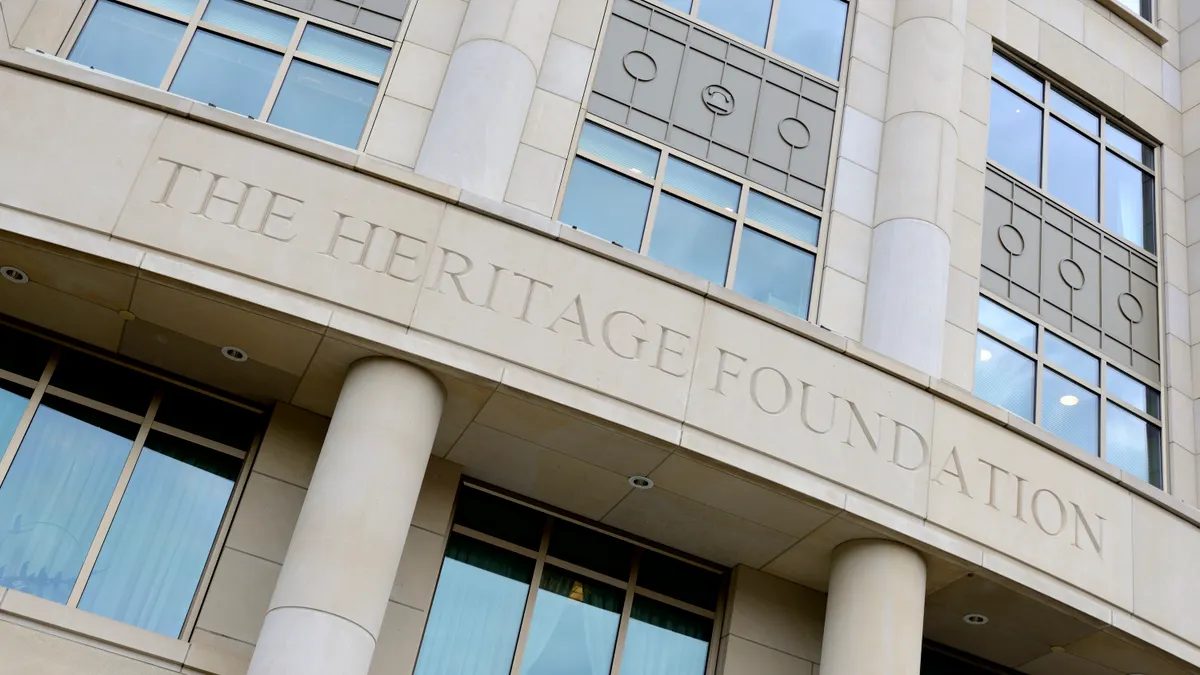
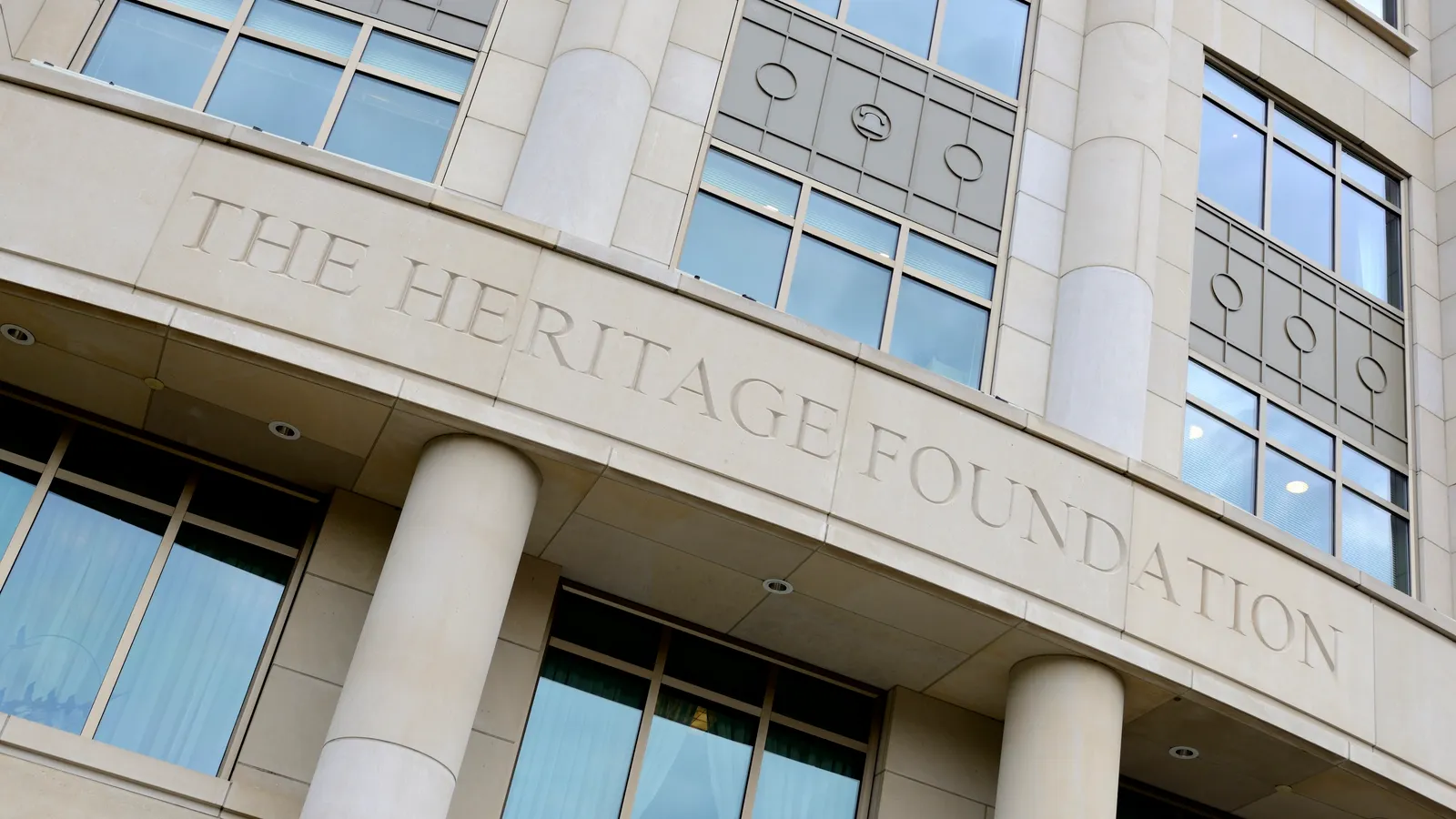
The Heritage Foundation's headquarters is pictured on Oct. 2, 2012, in Washington, D.C. RoosterHD via Getty Images Listen to the article 5 min This audio is auto-generated. Please let us know if you have feedback. Dive Brief:
- The Heritage Foundation, a powerful conservative think tank, released a model bill Tuesday designed to help state lawmakers "codify the principles" of the higher education compact proposed by the Trump administration last year.
- Like the compact, the extensive legislative proposal seeks to require colleges to maintain institutional neutrality and ban scholarships that give advantages to applicants based on race.
- However, the model legislation significantly differs and often goes further than the Trump administration’s compact. It would also restrict how institutions handle student visa issues, increase state influence over faculty hiring, and potentially put colleges on the hook for federal debt held by some students who don't graduate within eight years.
if (window.dfp_visibility === 'mobile' ) googletag.cmd.push(function() googletag.defineSlot( '/3618/highereddive/highereddivehybrid1', [[300, 250], 'fluid'], 'dfp-hybrid1-mobile' ).addService(googletag.pubads()); ); waitToLoadAds.push(function() googletag.cmd.push(function() if (window.dfp_visibility === 'mobile' ) window.onDvtagReady?.(() => googletag.display('dfp-hybrid1-mobile')); googletag.pubads().addEventListener('slotRenderEnded', function (event) var adUnitPath = '/3618/highereddive/highereddivehybrid1'; var onProformative = false; if (onProformative && event.slot.getAdUnitPath() === adUnitPath && !event.isEmpty ) var adUnitPathWithVisibility = adUnitPath + '-mobile'; var selector = '.pf-comments__ad-wrapper #dfp-hybrid1-mobile'; if (!$(selector).closest('.pf-comments__ad-wrapper').hasClass('borders')) $(selector).closest('.pf-comments__ad-wrapper').addClass('borders') ); ); ); if (window.dfp_visibility === 'desktop' ) googletag.cmd.push(function() googletag.defineSlot( '/3618/highereddive/highereddivehybrid2', [[300, 250], 'fluid'], 'dfp-hybrid2-desktop' ).addService(googletag.pubads()); ); waitToLoadAds.push(function() googletag.cmd.push(function() if (window.dfp_visibility === 'desktop' ) window.onDvtagReady?.(() => googletag.display('dfp-hybrid2-desktop')); googletag.pubads().addEventListener('slotRenderEnded', function (event) var adUnitPath = '/3618/highereddive/highereddivehybrid2'; var onProformative = false; if (onProformative && event.slot.getAdUnitPath() === adUnitPath && !event.isEmpty ) var adUnitPathWithVisibility = adUnitPath + '-desktop'; var selector = '.pf-comments__ad-wrapper #dfp-hybrid2-desktop'; if (!$(selector).closest('.pf-comments__ad-wrapper').hasClass('borders')) $(selector).closest('.pf-comments__ad-wrapper').addClass('borders') ); ); ); Dive Insight:
The model legislation is something of a conservative wishlist, outlining restrictions and requirements for colleges that would dramatically reshape higher education. Model legislation from conservative think tanks has significantly influenced state higher education policy in recent years.
A 2024 report from the American Association of University Professors contended that The Heritage Foundation and 10 other think tanks — funded by a coterie of wealthy donors — "found success in fomenting a culture war backlash against K-12 and higher education,” including through drafting model legislation.
The Trump administration initially offered its higher education compact to nine high-profile research universities last year before opening the invitation to all colleges. Among its numerous policy proposals, the compact sought to have colleges cap international enrollment, freeze tuition for five years, and potentially eliminate campus units that “purposefully punish” and “belittle” conservative viewpoints. In return, the administration said signatories would get priority for federal research funding.
None of the nine universities accepted the compact, and only a few colleges ultimately expressed public interest.
The Heritage Foundation argued the compact focused on principles such as merit, student learning and free inquiry.
"All institutions should commit to these priorities without needing a federal compact," The Heritage Foundation said Tuesday. "Since so few institutions demonstrate a focus on these principles, the compact was a necessary reminder."
Now, The Heritage Foundation is paving the way for state lawmakers — rather than college officials — to sign on to a conservative agenda. But rather than promise additional funding, its proposal would potentially tie compliance to state money.
Excerpt from The Heritage Foundation model bill:
"If a public institution of higher education admits a student who, on the basis of a standardized test, secondary school grades, other measures that predict graduation from the institution, or any combination of these, has less than a [X] percent likelihood of graduation within four years or less than a [X] percent likelihood of graduation within six years, and if that student does not graduate within eight years, the institution shall pay off [X] percent of the student’s remaining federal student loan debt associated with the student’s degree program."
Under the model bill, public colleges could risk being on the hook for some students' debt if they fail to graduate within eight years.
Colleges that accept an applicant who is unlikely to graduate on time — as determined by metrics such as their GPA and standardized test scores — would have to pay off a percentage of that student's remaining federal student loan debt, according to the bill.
The Heritage Foundation left it to states to determine those metrics, such as the threshold for determining which students were unlikely to graduate on time.
A section titled "Deportable Offenses" seeks to regulate how colleges handle international students and noncitizen employees in visa disputes with the Trump administration. Colleges would be required to "immediately suspend or terminate the individual’s enrollment or employment" if notified by a federal agency that their visa had been invalidated.
During its early months, the second Trump administration canceled hundreds of international students' legal status, often without notification or explanation. The flood of revocations prompted mass confusion and a wave of lawsuits. In April, a government lawyer said the Trump administration would temporarily reverse the cancellations while it created a formal policy for terminating international student records.
Had any state enacted the clause proposed by the Heritage Foundation at that time, its colleges would have been required to unenroll affected students who would have had their legal status restored only weeks later.
The model legislation also would tighten reporting requirements for colleges’ foreign gifts and contracts.
Under a decades-old federal law, colleges must report to the federal government any contracts and donations from foreign countries worth at least $250,000. The Heritage Foundation's model bill would lower that threshold to $50,000.
The foundation proposed several other changes not listed in Trump's compact, including:
- Prohibiting DEI offices or the promotion of DEI-related programs and practices at public colleges.
- Establishing that a public college's governing board or state regulator can ban a course from the state's general education curricula for any reason, including "failure to ensure a broad spectrum of viewpoints."
- Require “free expression training” for all new students.
- Barring colleges from offering a formal channel for reporting student speech that includes "perceived bias, prejudice, stereotypes, or intolerance."
- Prioritizing the hiring of faculty members "in academic subfields that are not well represented in an academic unit."
- Blocking public colleges from modifying their corporate activities "to foster social or political values."
The Trump administration has recently revived some of the policy goals in its compact.
In a letter this week, U.S. Education Secretary Linda McMahon outlined sweeping reforms that she urged college leaders to publicly commit to by the end of the year. Many of the issues she highlighted echoed those in the higher ed compact, including a focus on intellectual diversity and campus protest rules
- Add us on Google
- Share
- Copy link
- Email
- LinkedIn
- X/Twitter
- Facebook
- Print
-
 License
-
Filed Under: Federal Policy, State Policy Higher Ed Dive news delivered to your inbox
Get the free daily newsletter read by industry experts
Email:
- Select user consent: By signing up to receive our newsletter, you agree to our Terms of Use and Privacy Policy. You can unsubscribe at anytime.
Sign up A valid email address is required. Please select at least one newsletter.Editors' picks
-
 Rob Carr / Staff via Getty ImagesJohns Hopkins lays off 110 employees in the wake of federal research cutsBy Ben Unglesbee • June 26, 2026
 -
 Getty ImagesETS acquires ACT, consolidating two testing giantsBy Ben Unglesbee • June 30, 2026
ES by OMG
Euro-Savings.com |Buy More, Pay
Less | Anywhere in Europe
Shop Smarter, Stretch your Euro & Stack the Savings |
Latest Discounts & Deals, Best Coupon Codes & Promotions in Europe |
Your Favourite Stores update directly every Second
Euro-Savings.com or ES lets you buy more and pay less
anywhere in Europe. Shop Smarter on ES Today. Sign-up to receive Latest
Discounts, Deals, Coupon Codes & Promotions. With Direct Brand Updates
every second, ES is Every Shopper’s Dream come true! Stretch your dollar now
with ES. Start saving today!
Originally posted on: https://www.highereddive.com/news/the-heritage-foundation-releases-sweeping-model-bill-to-overhaul-higher-ed/827280/