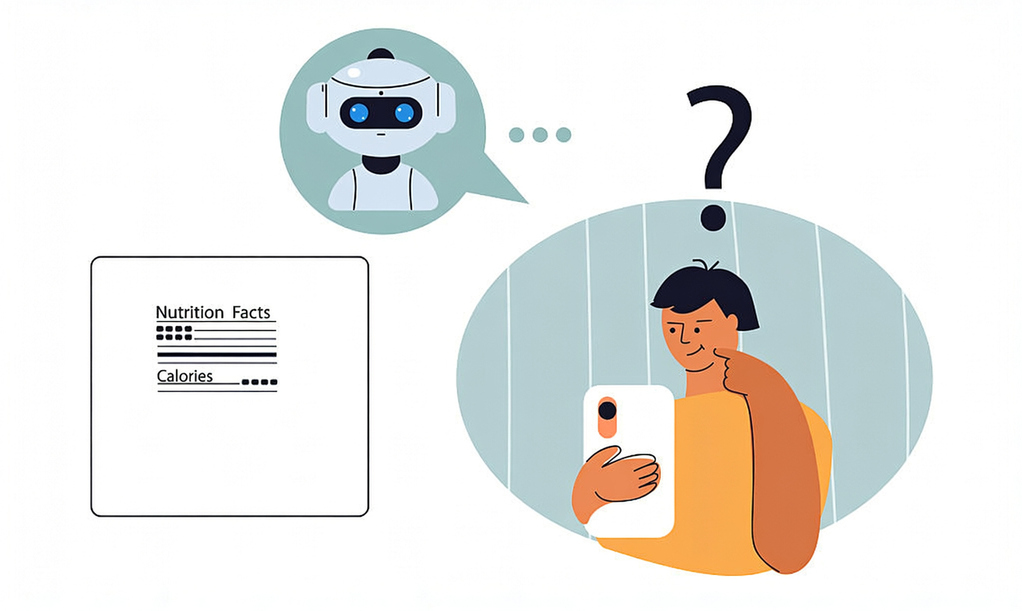
The Cognitive Concern: Why AI Needs a Nutrition Label
In the late 1970s, America had a collective awakening. For decades, the food industry had flourished, offering convenience and endless variety, largely in the absence of robust public health oversight. It took the official declaration of the 1977 McGovern Report to crystallize and politically amplify the long-term cost of a diet built on processed foods.
The food industry’s response prioritized marketability. When the public was told ‘fat is bad,’ companies rushed to create ‘low-fat’ products, which were often loaded with extra sugar to compensate for taste. The critical issue wasn’t the calorie count; it was the hidden, unhealthy trade-off that was not clearly communicated. Without a deep understanding of nutritional science, the public happily consumed these new products, unaware of the unhealthy choices they were making. It took decades of advocacy culminating in the 1990 Nutrition Labeling and Education Act to give consumers a standardized tool to navigate this confusing landscape. This is the perfect historical parallel for our current moment with generative artificial intelligence.
AI as the New Convenience Food
Generative AI offers the same irresistible combination the snack industry sold decades ago: speed, ease, and instant gratification. It is the new convenience food of the mind. It seems to solve every small, immediate problem, from drafting an email to composing a syllabus.
But just as early convenience foods prioritized taste over nutritional value, many of the AI tools we are adopting are prioritizing speed and efficiency over intellectual depth and human insight.
The problem is when convenience outruns understanding. Right now, the average faculty member or student has about as much grasp of AI’s mechanics, limits, and long-term effects as a 1960s consumer had about trans fats or high-fructose corn syrup. We are actively consuming without taking the necessary steps to understand the risks involved.
The most dangerous unlabeled ingredient in AI is the loss of cognitive friction. As AI becomes more prevalent, there’s a concern that human intelligence could diminish. Over-reliance on AI might lead to passive information consumption, hindering our original thought, creativity, and critical thinking. Our ability to synthesize information and generate new ideas, data, and code could decay, turning us into mere readers rather than creators of understanding.
Guiding AI to Augmentation, Not Addiction
The dominant view of AI portrays it as a force of displacement, suggesting it will replace jobs, creative work, and even human thought. This narrative is intensified by the term “artificial intelligence” itself. “Artificial” implies a fabricated, inferior imitation, subtly framing AI as a rival rather than a potential human partner.
But a strong, publicly educated counter-narrative can guide the technology toward augmentation, using AI to amplify, rather than substitute, human cognition. This must be the core message we, as educators, champion, actively reframing the discussion away from the limiting implications of “artificial” and towards the empowering potential of “augmented”:
- Amplifying Critical Thinking:Instead of using AI to summarize a book, we should be using it to debate an argument, identify underlying assumptions in a text, or test the edges of a complex theory. AI becomes a high-powered sparring partner, not a cheat sheet.
- Driving Scientific Discovery:This is AI not replacing a researcher, but multiplying their capacity for insight by sifting through millions of data points, allowing the human to focus on novel hypotheses.
- Enhancing Creativity:The human remains the visionary and the editor of the AI’s output, using it to rapidly accelerate the iteration and testing of ideas before committing to a final vision.
Making AI Literacy a Public Health Imperative
We missed the window once with what we put in our bodies. We don’t have to miss it again with what we feed our minds.
We cannot wait decades for a federal law to mandate transparency. Instead, we must treat AI literacy as a public health campaign on our campuses and in our schools, ensuring our students and colleagues understand the trade-offs they are making.
To make this vision a reality, we must:
The snack food industry created an environment where convenience trumped health because the public lacked the tools to understand the trade-off. We have a chance right now, before the current generation of AI models becomes fully entrenched, to prevent a similar crisis of cognitive atrophy.
Acknowledgements: I would like to thank my colleague Toni Gist for reviewing an early draft and acknowledge the use of Google Gemini for refinement of style and clarity. The human author is solely responsible for any errors or inaccuracies presented.
Jim Wentworth is the Associate Director Educational Innovation at The Center for Innovation in Teaching & Learning at the University of Illinois Urbana-Champaign. He oversees the Instructional Development and Instructional Design teams at CITL. His amazing colleagues are responsible for designing, developing and delivering high-quality faculty development opportunities and course design services that meet the evolving challenges facing instructors on our campus. They are in the process of integrating these two teams to create the next generation of academic professionals able to support the design, production, and teaching of courses across all modalities.
Post Views: 104
ES by OMG
Euro-Savings.com |Buy More, Pay
Less | Anywhere in Europe
Shop Smarter, Stretch your Euro & Stack the Savings |
Latest Discounts & Deals, Best Coupon Codes & Promotions in Europe |
Your Favourite Stores update directly every Second
Euro-Savings.com or ES lets you buy more and pay less
anywhere in Europe. Shop Smarter on ES Today. Sign-up to receive Latest
Discounts, Deals, Coupon Codes & Promotions. With Direct Brand Updates
every second, ES is Every Shopper’s Dream come true! Stretch your dollar now
with ES. Start saving today!
Originally posted on: https://s39613.pcdn.co/articles/teaching-with-technology-articles/the-cognitive-concern-why-ai-needs-a-nutrition-label/